Real Raw Lemon Cheese Cake Recipe

After a short break in London, we’re back on the road. We’re heading to Croatia, but had a little detour to Slovenia. It’s a beautiful country, loads of forest and wild nature. On Saturday we went to Ljubljana, the capital and found an amazing market. Loads of organic veg stalls, plus we got organic raw milk, raw butter, raw sour cream and raw cheese.

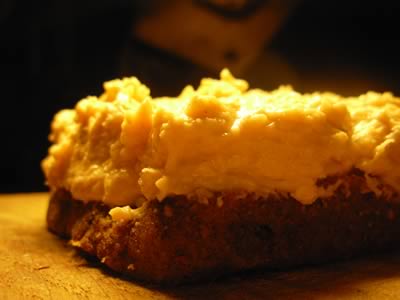
I love cheesecake, and it is actually very easy to make raw cheesecake, assuming you can get some good raw cheese to start with. We got some soft plain curd cheese, it needs to be fairly plain to make into cheesecake.

I didn’t measure the ingredients, but I think this is a recipe where it is hard to go wrong.
Base
Brazil nuts
apricots
a few cacao beans or nibs (optional)
1 tsp vanilla powder
grated lemon rind

Topping
cheese
lucuma
honey
grated lemon rind

For the base, you want an approximately equal amount of nuts and dried fruit, you can use various combinations of fruits and nuts. I soaked the apricots for a couple of hours so they would process easier, but you don’t want them too wet otherwise the base will be soggy. Put all the ingredients in a food processor until it forms a sticky ball. If you need more liquid you can either add a little lemon juice or water. As you may know, I don’t generally eat dehydrated food as I find it hard to digest, so this base was soft and sticky, but you could probably dehydrate this is you want a more traditional cheesecake.

For the topping, just mix all the ingredients together. The more lucuma you add, the thicker the mixture will become. And of course, the more honey, the sweeter. (The cheese I used was very soft so I only needed to mix it with a spoon, with a firmer cheese you may need to blend.)

I’m sure there are many variations you can make instead of lemon.

Learning from Tribal People: Book Review

I’ve read a few really excellent books recently which I want to share with you all. I’ve just finished reading Don’t Sleep, There Are Snakes by Daniel Everett. This book defies categorisation, on the back it says “Travel/Linguistics”, both of which are correct, but this book covers so much more than that. Daniel was a Christian missionary who went to try to convert an Amazonian tribe, the Pirahá, to Christianity. To do this, his first task was to learn the language and then translate the New Testament of the Bible to the Pirahá language. This might not sound too difficult, but Pirahá doesn’t have a written form, no-one else speaks it, there are no dictionaries or teach yourself courses, and the Pirahá people don’t speak any other language (apart from a few words of Portuguese). So Daniel moves, with his family, to a Pirahá village to live with these people and learn their language. (Daniel is a trained linguist so he does know how to go about the task.)

The book is in three parts: Life, Language and Conclusion.

Part 1, Life, which is the largest section of the book, is a selection of experiences, challenges and insights during Daniel’s life while living with the Pirahá people. One of the most fascinating things about the Pirahá is that they seem to live in the present moment, much more than us westerners could even imagine possible. They have a very minimal amount of personal possessions. In general, they do not store food – they go out hunting/gathering almost every day, if they don’t, they don’t eat that day (which is ok by them, a self imposed fast).

The Pirahá people will only talk about things that they themselves have experienced, or that someone else they know who is still living has experienced. This was one of the major challenges Daniel encountered when attempting to talk about Jesus – once the Pirahá realised that Daniel had never met Jesus, and that Jesus died a long long time ago, they weren’t interested!

The second part, Language, goes into much more detail about the Pirahá language. I found the first half of this interesting and easy to read, although the second half started getting much more technical and possibly only interesting to linguists. But even if you skip part of this section, it doesn’t detract from the rest of the book, and it is only a small part of the whole book.

The conclusion contains the information that convinced me to read this book in the first place – after living with the Pirahá people for many years, Daniel didn’t manage to convert a single Pirahá, and in the end Daniel stopped believing himself. To ‘save’ someone by converting them to Christianity, they would need something to be saved from, and Daniel found that the Pirahá were the happiest people he ever met, and didn’t need saving!

I highly recommend this book, there is so much to be learnt from the Pirahá people.

Yummy Scrummy Chocolate Brownie Review

Wow, this was delicious! A chocolate brownie with a chocolate topping with the perfect brownie flavour, coming from the well chose ingredients including walnuts, Brazil nuts, goji berries, raisins and dates. Plus it looks great too!

For anyone strictly raw, this product does contain Sweet Freedom which is a natural fruit based sweetener that isn’t raw, but the other 95% of the ingredients are raw.

It’s just won the Taste of the West Gold award, so another vote for how good it tastes.

For more information and to order, see the Elemnts for Life website.

Raw Milk, Raw Cream and Raw Butter Delivered

In the UK, the law says that you can only buy raw milk direct from the farmer. Which makes buying raw dairy products quite difficult for most people. So I’m excited to tell you about the service from Hook and Son, I got my delivery today. They’ve been delivering raw milk for a while now, and they have just added the raw cream and raw butter to their service.

And even better, if you live in their local area (Eastbourne area) they will deliver in glass bottles, and collect the used ones for re-use, just like in the ‘olden days’!

For more information and to place your order see www.hookandson.co.uk

Recipe: Quick and Easy Fermented Courgettes

Fermented foods have become a big part of my diet in the last 6 months or so. Kefir, sauerkraut, kombucha, fermented vegetables and more. It was the book Wild Fermentation that got me started and I’ve not looked back. I’ve recently discovered a very simple fermented food which can be made in minutes, although of course you need to wait for them to ferment, usually around 3 days: fermented whole courgettes.

For this to work, you need very small courgettes. The ones in the photo are probably a bit too big, it works better with smaller ones.
The process is really simple:

1) Take a kilner jar, (or a screw top jar) and wash well with hot water. The larger the jar, the better, the jar pictured is 1.7 litres.

2) Fill jar with whole courgettes.

3) If desired you can add some flavouring, I’ve used various combinations of grated ginger, grated turmeric, crushed coriander seeds and crushed cumin seeds. It does also work well without any flavouring, just experiment and see what you like.

4) Mix the brine – for each litre of your jar, use 1 teaspoon of salt, so for example for this 1.7 litre jar, use approx 1.7 teaspoons of salt. Mix with water and add to the courgettes so they are completely covered. If necessary, use something to push them under the water if they are floating to the top – a boiled and scrubbed stone works well.

And that’s it. Check every day that the courgettes are still completely submerged, and remove any scum that may form on top. Taste after 3 days. After 6 days or so (or once they are to your liking) you might want to put them in the fridge to stop them fermenting any more.

In hot weather the fermentation happens quicker, in cold weather slower. The more salt you add, the slower the fermentation, so in really hot weather adding more salt can slow the fermentation down and in cold weather less salt will speed up the fermentation.

If you can’t find small enough courgettes, you can also use larger ones and slice them. Make the slices quite thick slices, around 1cm each.

Let me know your favourite fermented recipes in the comments…

Review of Raw Food Controversies by Frederic Patenaude

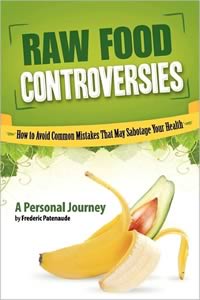
Why do some people fail on the raw food diet? That is the question that Frederic attempts to answer in his new book “Raw Food Controversies”. He does this by taking us for a ride on his journey over the last 14 years of his life, starting right back at the birth of the modern day raw food movement. The first part of this book is essentially an autobiography, with Frederic including every detail of his life (or so it seems) including his love life, how he met and became friends with David Wolfe and got to work for Natures First Law, and how he met many other famous raw food pioneers including David Klein, Juliano, David Jubb and more. If you have been involved with the raw food movement for many years, you might, like myself, find this section fascinating. If, on the other hand, you are new to the raw diet, you might, like a friend of mine, keep wondering when Frederic is going to get to the point.

This book is very refreshing in that Frederic questions the raw diet, none of the “raw is the best, raw will cure everything” some books are guilty of. Frederic experimented with various different raw diets, including animal foods, fasting even returning to cooked foods for some periods. He realised that raw diet is not simply eating all your food raw and hoping for the best, it needs careful planning.

The first few years on a raw diet left Frederic with a mouth full of cavities, which he discusses in detail, including his view on what cause the problem, and the solutions. If you read this book, I recommend you also read Cure Tooth Decay by Ramiel Nagel, for a completely different view on the subject (I don’t claim to know which author is correct, but if you have problems with your teeth, it’s best to read both opinions).

Towards the end, Frederic starts to pinpoint what he considers to be the ideal raw diet, which is a low fat vegan diet, with lots of fruit. Which is great that he has found a diet that works for himself, but I don’t agree with his belief that the same diet (with minor variations) will work for everyone. One example of how we are all different is the conversion of beta-carotene into vitamin A – we all have a differing ability to make this conversion and those people where this conversion is not optimal will not thrive on a vegan diet.

Frederic recommends a diet containing 7-15% fat, saying that before Western Civilisation took over, most people ate low fat diets, but he misses the research by Weston Price who found that traditional peoples ate diets which contained between 30-80% fat.

I realise that this review is critical, I think that is because this book is written in a way that attempts to show that Frederic’s current diet is the ideal diet for everyone, which I just can’t agree with. So, by all means read this book, but do it with an open mind. It is a very good book, I enjoyed reading it, and it makes some very good points. And the diet recommended might just work for you, but there is also a good chance that it won’t.

Available direct from Frederic’s website.

This review was first published in Issue 19 of the Funky Raw magazine.

Juice in a Bar review

I was sent samples of Jason Vale’s new raw Juice Bars: Veggie Juice in a Bar and Super Fruit Juice in a Bar. I was intrigued at the idea of how they could make juice into a bar, the answer was obvious once I looked at the ingredients – the first two ingredients for both bars are dates and almond butter, so these are standard energy bars with the addition of juice. I can’t see anywhere where it says the percentage of juice compared to the base ingredients.

First I tried the Super Fruit bar – first reaction is that it is very sweet, with the dates overpowering the flavour of the juices. Overall a nice bar, although I wouldn’t buy it as it is so sweet.

Much better, the greens tempering the sweetness a little, so while still sweet, a much more balanced bar. There is a “green” flavour to this bar which some people might not like (my Dad liked it and my Mum didn’t), but it’s worth it to get the mineral rich greens. If you generally eat this kind of energy bar, then maybe switching to this one would be a good move so you get a load of nutrition from the greens and algaes into your diet. It contains a lot of good ingredients including wheatgrass, dandelion juice, kale juice, spirulina, chlorella, kelp and dulse, plus also digestive enzymes. I would be interested in what percentage of the bar the dates and almonds make up. Of course if you have the option, I would recommend a fresh green juice, preferably made with lots of wild greens, but if you don’t have that option then this is an ok substitute. But don’t go overboard, there are still a lot of dates in this bar.

Find out more and order at www.juicemaster.com

The Funky Raw Magazine

If you don’t already know, I publish a quarterly magazine, the main topic of which is raw food and healthy eating, but it also covers many other topics including environmentally friendly living, permaculture and growing food, spirituality, living consciously and more. It is a grassroots magazine, mostly written not by journalists but by people writing from their own experiences.

If you want to see for yourself what it is like we now have two back issues available as free ebooks (PDF files), follow the links to download your copy: Issue 10 (Spring 2007) and Issue 18 (Winter 2010/11). If you prefer printed copies, we have two selections of back issues available at a discount: Issues 14 to 18 and Issues 4,5,6,11 & 13. The current magazine is Issue 19 Spring 2011 which can be purchased as a printed magazine or an ebook. Why not subscribe and get each issue delivered direct to your door.

There are several ways I want to take the magazine forwards which I want to talk about more below.

Writing for the magazine

I’m always open for new writers, whether for a single article or to be a regular writer. You can write on raw food or any related conscious living subject, the main rule is to keep it positive – the news media is full of negativity so at Funky Raw we try and look to how to move forward positively. There is a list of article ideas on this page, but if you have your own ideas please also get in touch.

As well as feature articles, there is also space for news, raw recipes, reviews (books, films, restaurants, etc), cartoons, poetry, etc. There is no set length for articles, short articles can work just as well as long articles.

Every cover features artwork, while I have artists lined up for the next couple of issues, please feel free to contact me if you would like to offer your artwork.

Distribution

In the UK and Ireland we are distributed by Ink Distribution. If you want to get your local health food shop to stock the Funky Raw magazine, tell them to order it through Ink Distribution. Otherwise, wholesale copies of the magazine can be ordered direct through our online shop or by contacting me directly on magazine@funkyraw.com

It would be great to get the magazine distributed in the USA and Canada, if you have any ideas on this please get in touch.

Spreading the word

If you have a blog or website and would like to write a review of the magazine, email me at magazine@funkyraw.com and I will send you a free copy. If you have any other ideas on how to promote the magazine, please leave a comment or email me.

Testamonials

Here’s what some people have said about the magazine:

I have so many books on nutrition at all levels, watch YouTube discussions on raw eating, David Wolfe, etc, but none of them compare to your magazine!! I have ordered some back issues and re-read them over and over, even going to take them on holiday with me next month. Why? because I find that the articles you print are varied, motivating and informative and better than any book because there is always another to look forward to. Please don’t ever change how you present this magazine, it out rivals its high gloss contenders in its simplicity (in the best kind of way) it is perfect. I see your magazine as the bridge for me to reach my goal of becoming a Raw Food Eater!!!! It is the inspiration I need. – Deana, Essex

Just to say I loved your magazine. I ready it cover to cover. It was refreshing to read media that is ‘real’ like from person to person sharing stories and wisdom rather than the usual. I really liked the cover artwork too. – Fiona

Remember, you can download a free PDF version of these two issues, just click the cover images below:

Crucina – New raw food restaurant in Madrid

We’re on our way north again, heading back to the UK for a little while. As we were passing near to Madrid we decided to take the opportunity to visit Crucina, probably Spain’s only 100% raw restaurant. Crucina is a combination of two Spanish words – the start of crude meaning raw and cocina meaning kitchen.

Crucina is centrally located in the Malasaña district of Madrid, less than 5 minutes walk from San Bernardo metro startion.

We arrived to a very warm and friendly welcome from Yorgo, one of the co-owners. The ambiance is great, smart and modern, although they do have plans to make the décor more unique and creative. The menu was of course in Spanish, they are planning to have English menus, but for now both owners speak English so they can translate anything you don’t understand. The menu is comprehensive: juices, soups, salads, starters, mains, deserts and drinks.

We started with juices – I had “Purificaverde” – Green Purification with spinach, cucumber, celery and lemon, very refreshing although a little bland (I’m used to much stronger wild green juices!). Jolita had “Anticolesterol” with carrot, ginger, apple and parsley, which was delicious. (We shared all our food, so got to taste twice as much!)

For starters, I had the “Trio de Tartletas”, three little savory tarts, each with a different filling. The ‘pastry’ casing was unfortunately a bit too hard, almost rock solid and I couldn’t eat it, although the fillings were really delicious. Jolita had the “Tabla de Kesos”, the cheese plate. In Spanish, cheese is spelled Queso, so the alternative spelling Keso is to denote vegan cheese! Two different nut based cheeses, some raw jam, and at least 4 types of raw crackers, it was all delicious.

Trio de Tarteletas Cheese Plate

MoussakaI always used to love Moussaka when I ate cooked food, so when I saw it first on the menu, I just had to have it. After reading further it was a toss up between that and the Saag Hindu, but Jolita chose that so all was well. It turns out that Yorgo is originally from Greece, and he wants to include more Greek dishes in the future.

The moussaka was great – aubergine is not always the best thing raw, but they suceeded by cutting it very thinly and dehydrating – it was a bit chewy but good. The ‘meat’ was tasty and the ‘cheese’ and tomato sauces were delicious, overall a great dish, just slightly too salty for me (I don’t usually add salt to my food, so I’m quite sensitive  to too much salt).

Saag HinduSaag Hindu was a spicy Indian dish made with spinach and ‘mango chutney’ (more a mango sauce than chutney) which was served with some spicy coconut based breads. This again was delicious, the spicyness was just right, tasted like food from an Indian restaurant!

I was getting a bit full by now, but the deserts sounded too tempting to pass over. We ordered the tiramisu and the “Pudin de Chia”. The chia pudding was good, but a little bland, although the strawberries and banana it was served with did go well with it.

The tiramisu was amazing! Excellent textures and flavours, definitely among the best raw deserts I have ever eaten.

Chia Pudding Tiramisu

In conclusion, if you are anywhere near Madrid this is well worth a visit. And their plan is to open another restaurant in Barcelona later in the year, so keep listening out for news of that.

Crucina, Divino Pastor, 30, Madrid. Tel: 914453364. Opening hours: Tues – Wed: 13:30 – 16:00, Thurs – Sat: 13:30 – 16:00 and 21:00-24:00, Sun: 13:30 – 16:00