Pumpkin Pate with Kelp and Chlorella

I wanted to make something with both kelp and chlorella, it was a bit of a random experiment but it turned out really nice.

Grate the ginger and stir in the oil. Add the powders and stir in. Grate the pumpkin on the finest grater you have, I think what I used is called a microplane, a really fine grater. I guess you could blend or food process the pumpkin instead if you prefer. Mix the grated pumpkin in with everything else. Hope you like it!

How to Protect Yourself from Radiation

David Wolfe has done an excellent podcast on how to protect yourself from radioactive fallout – I recommend you listen to it now: David Wolfe on Radiation. Here’s a quick summary of what he recommend to take, many of which we sell on the Funky Raw website, so I’ve linked these items:

  • Kelp – for iodine (all seaweeds are good, but kelp has the most bio-available iodine).
  • Ginseng
  • Ashwaganda
  • Chlorella (for the chlorophyll, chlorella is the food highest in chlorophyll, 40 times higher than wheatgrass)
  • Zeolite (for detoxing)
  • Fulvic acid
  • Sea salt and salty miso
He also says that the following are useful:

Fermented Broccoli and Carrot with Leek

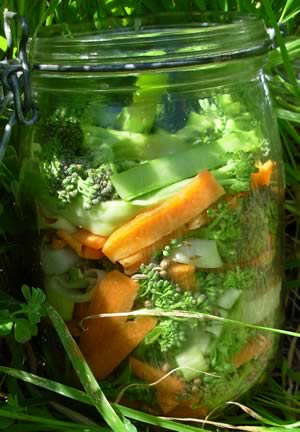
Fermented broccoli and carrotThis was my first attempted at fermenting vegetables and it worked really well, although I think I put too much salt in. I followed the technique on pages 50-52 in the book Wild Fermentation “Sour Pickles”.

I sliced the carrots and cut the broccoli up, you can see the approximate sizes in the photo. I then sliced some leek,  I think I used about 1/4 of a leek. I used a couple of handfuls of coriander seeds and cumin seeds to flavour it, some whole and some crushed.

I put everything in a kilner jar and added water with salt dissolved in it, I think for this 1 litre jar I used 500 ml water with 1 and a half tablespoons of salt, but if I did it again I would use less. I then put a clean (well scrubbed) stone on top of the veg to hold it under the saltwater solution. After about 2 weeks fermenting they had an amazing flavour, but you can try them during the whole process to see how they develop.

You need to check them daily and if any mould forms on the surface it needs to be removed.

Photos from our travels: Part 5 – Basque Country and Pyrenees

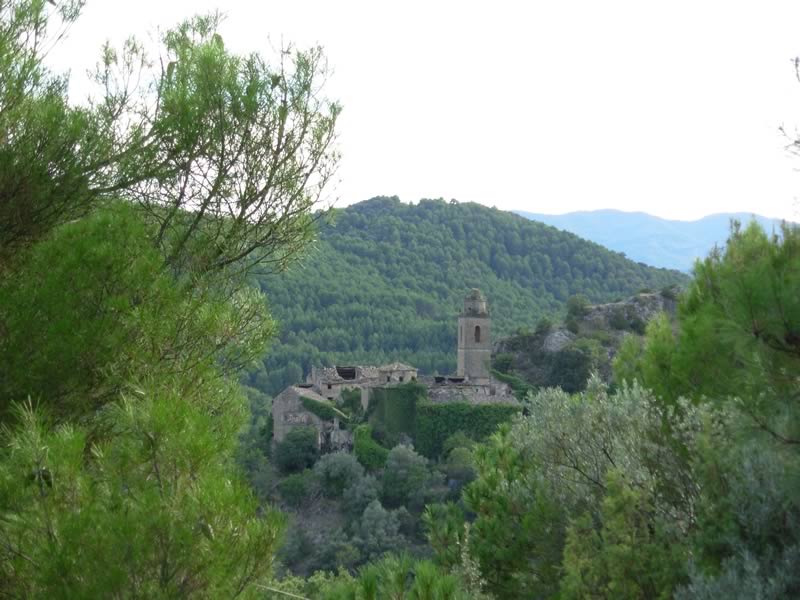
Some beautiful scenery in this part of the world. This is the final part of this section of our trip, from Bagneres de Bigorre we drove through the Pyrenees into Spain, across to the Spanish and then French Basque Country then along the Spanish coast to Santander where we took the 24 hour ferry to Portsmouth – we then spent a month in the UK, mostly in London.

Basque Country - map 5

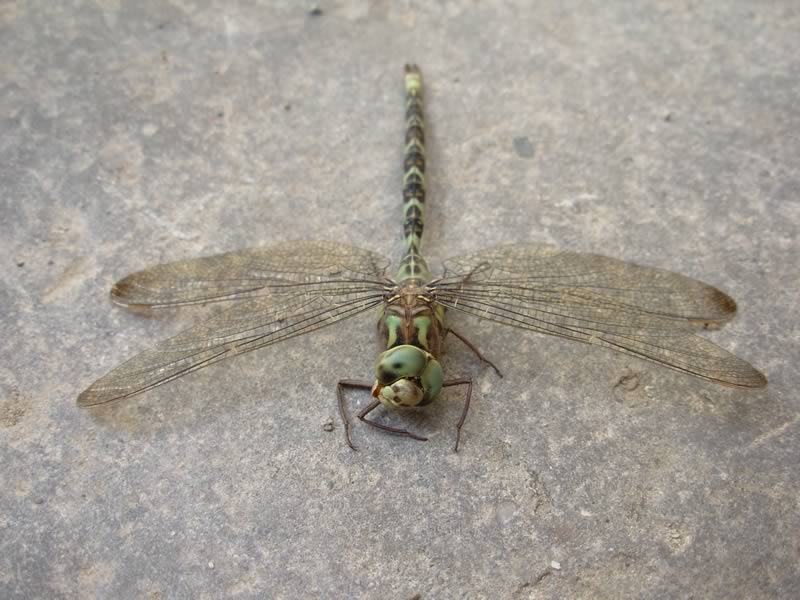
Ainsa, our first stop in Spain. I have a friend who was staying there and she took us to visit a local lady who was growing all sorts of food plants, we ate some delicious figs and I got to try fresh stevia leaves for the first time (first photo), they are amazing, so sweet! The dragonfly was dead on the ground, but it gave me a good opportunity to take some photos.
The road out of Ainsa towards Jaca was amazingly beautiful. We just kept stopping to take photos! Parque Nacional de Ordesa y Monte Perdido
Parque Nacional de Ordesa y Monte Perdido, in the Pyrenees on the border between Spain and France – well worth a vist, amazing waterfalls.
Back in France, Saint-Jean-de-Luz The Atlantic coast of France here is beautiful. This is Lac Blanc, a little inland from Vieux-Boucau. Bayonne was a very pretty city.
Guggenheim Museum, Bilbao
Bilbao: Outside the Guggenheim Museum were several sculptures, including this dog made out of flowers and giant spider. And of course, the obligatory photo of the Guggenheim Museum!

Photos from our travels: Part 4 – French Pyrenees

This was a beautiful part of France. Châteaux, mountains, hot springs, French markets and lots more, from 17th August to 5th September 2010. Click to enlarge the map or photos.

Carcasonne has an amazing fairy tale Château, and is generally a very pretty place, but once you go inside, you are greeted with tacky souvenir shops.
This is the Château at Peyrepertuse, it’s an amazing old Cathar Castle built in the 11th Century. We’re big fans of hot springs, although at Rennes-les-Bains we only found the warm springs (still beautiful), this photo is nearby.
This is not far from the campsite we stayed on near Foix. In the evening we followed a footpath and went for a great walk, founds lots of wild food and saw wildlife like this butterfly.
In Saint-Lizzier near Saint-Girons, lots of interesting plants, including this kiwi vine. Bagnères-de-Luchon, beautiful place in the Pyrenees. Sunset from campsite at Bagnères-de-Bigorre.
Bagnères-de-Bigorre. We spent a week here, it was a beautiful place and I had some work to catch up on. Lots of walks in the surrounding countryside, some amazing views and wildlife and a great market on Saturday. As well as the amazing mushrooms and spider, we saw a hummingbird moth, which looks a bit like a hummingbird, but it was flapping its wings too fast to be able to take a good photo of it.

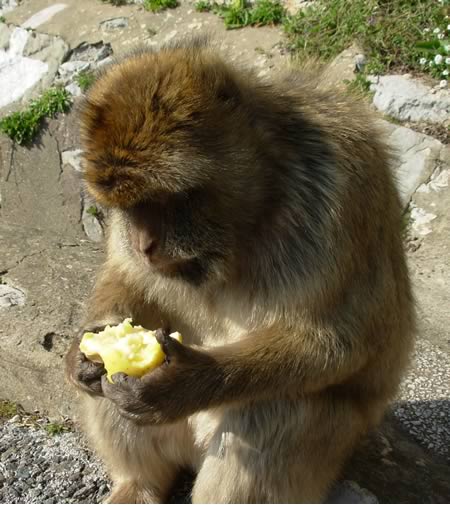
Monkey stole my apple!

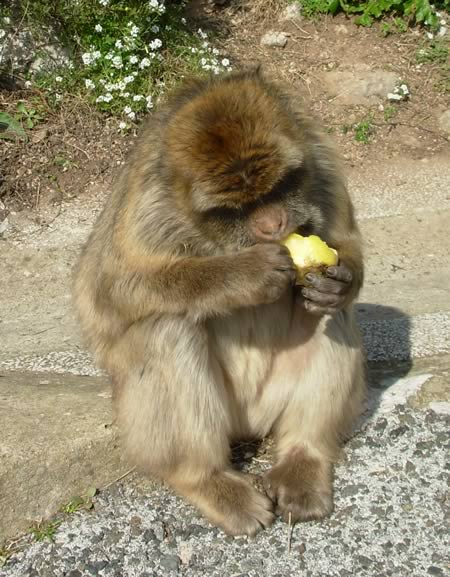
Today we went to Gibraltar – I’d heard that the Upper Rock Nature Reserve is the only place to have monkeys in the wild, specifically Barbary Macaques. I wasn’t really expecting to see them, but there were loads of them! At one point, I was walking along, happily eating an apple when one of the monkeys came up to me, climbed up my leg and grabbed my apple. Unfortunately this all happened too quickly to get on camera, but I did manage to take the following pics of the monkey eating the stolen apple:


My daily diet – what a raw fooder eats

My diet has changed a lot in the last year particularly with the addition of lots of fermented foods and more animal based foods. This is a typical day, obviously I don’t eat the same thing every day. And it’s an experimental diet, I could change it again at any point!

For breakfast, I eat a hemp milk pudding. In the past I’ve talked about this a lot (as chocolate pudding), although at the moment it usually doesn’t contain chocolate.

The ingredients are as follows (for 2 people):

  • 150g hemp seeds, soaked overnight
  • handful of seeds soaked overnight, drained and rinsed – different seed each day, rotated through sesame seeds, sunflower seeds and pumpkin seeds
  • 2 figs, 2 apricots and a handful of goji berries soaked overnight
  • 2 bananas
  • 2 teaspoons pollen
  • 2 teaspoons mesquite meal
  • 2 teaspoons carob powder
  • either 1 teaspoon maca or 1 teaspoon suma powder
  • 1/2 teaspoon camu camu powder
  • 1/2 teaspoon vanilla powder
  • 1 tablespoon butter (grass fed dairy butter)
  • 2 teaspoons coconut oil
  • piece of aloe vera about 5cm long (with skin removed) if available

Occasionally I’ll add some raw cacao beans, around 10 beans for 2 people. It’s not the same every day, ingredients vary depending on what is available. Pears work well when they are in season, sometimes to replace a banana. I won’t type the full method, you can see it in the previous choc pudding post, but basically make hemp milk and then blend it with all the other ingredients.

I eat the pudding with some kefir made with raw milk, usually goats milk while we are travelling in Spain. Kefir is a wonderful fermented foods full of probiotic bacteria. If available I will also have  a little raw cream or creme fraiche.

Update: I’ve started taking 5ml fermented cod liver oil and 2.5ml high vitamin butter oil along with my breakfast, to cover the important vitamins A, D3 and K2.

Lunch is usually composed of two separate smaller meals, one maybe around 12-1pm and the other around 3-4pm

Usually the first one will be some fruit, whatever is in season, at the moment maybe oranges, custard apples (cherimoya) or apples. At other times of the year figs, kakis, pears, plums, etc. Usually I will only eat one type of fruit in a meal.

Later I’ll have two or three raw egg yolks, beaten up with some kefir, and something to flavour it, mesquite, lucuma and raw honey works well. This is a new and experimental part of my diet, it seems to be working for me at the moment but I’ll see how it makes me feel over the long term.

Just before dinner I will have a glass of kombucha, before a meal it can help with digestion and detoxification.

Dinner is a large salad – lots of wild greens, half an avocado, seasonal vegetables, fermented foods like sauerkraut and home made pickled veg (see my review of Wild fermentation for more on fermented foods), seaweed and raw cheese. Once or twice a week I’m experimenting with more animal food, raw fish (marinated in lemon juice), raw cured meat or liver pate (some of the only cooked food I’m currently including.) This is based on information from Weston Price.

After dinner I’ll sometimes have a snack of dried figs with grass fed butter. Butter must be from grass fed animals for it to include the important vitamins A, D and K, plus activator X. With cows butter, the colour should be yellow, if it is white it doesn’t have the required nutrition. Try getting butter from your local farmers market, but if you have no success with getting quality butter, Kerrygold butter from Ireland is grass fed and high quality. (And Anchor butter from New Zealand if you are in that part of the world.)

Water: throughout the day I drink water with a squeeze of fresh lemon juice. I try to drink freshly collected spring water wherever possible. If not available, I will always filter tap water before drinking.

Some of you will be asking why? I think my previous diet contained too much fruit and this has caused problems with my teeth. I’ve been reading two books Diet and Nutritional Degeneration by Weston A. Price and Cure Tooth Decay by Ramiel Nagel which have helped me to change my diet. I’ve written more about Weston Price here: The key ingredients of healthy diets and I will write more about the Cure Tooth Decay book once I have finished reading it.

Wild Fermentation by Sandor Elix Katz – Book Review

This review was first published in Funky Raw issue 17, but I have been making more recipes from it since then so have added a bit of an update at the end.

The article on Wild Fermentation in the last issue of the Funky Raw magazine intrigued me so I went out and bought myself a copy of this book as recommended. I’ve recently been increasing the amount of fermented foods in my diet, both home made and store bought, so I thought it would be good to learn how to make more fermented foods for myself.

This book is very easy to read and much of what Sandor says resonates with me. The first few chapters set the scene, showing how past cultures used fermented foods and how things have changed with commercialisation and mass production of food in recent years.

I really like the fact that Sandor has written this book in a conversational style, and isn’t afraid to occasionally go off at a tangent, such as the time he went to harvest seaweed at 4am(!), plus interesting asides about life in the community where he lives.

Sandor has been learning about fermented foods for the last 10 years and the level of research which has gone into this book is astounding, it is well referenced and has a large bibliography so you can keep learning.

The book covers a wide range of fermented foods, some of which won’t be of interest if you are a strict raw fooder, but there are enough raw (or live) recipes to make this book worth while. Recipe chapters include vegetable ferments (sauerkraut, kimchi, pickles), bean ferments (miso, tamari, tempeh), dairy ferments (yogurt, kefir, cheese, vegan alternatives), bread, porridge, wines, beers and vinegars.

Each recipe is clearly laid out with detailed instructions, plus also ideas for making your own variations. Sandor keeps telling us how easy it is to make fermented foods – explaining how humans have been fermenting for thousands of years without any modern technology or shops to buy yeasts from, fermenting using wild yeasts and bacteria which is in the air all around us.

I thoroughly recommend this book, but if this review hasn’t convinced you, read the extract (printed in the Funky Raw magazine).

188 pages. Published by Chelsea Green. ISBN 978-1931498234. www.wildfermentation.com

Updated comments, Feb 16th

The first recipe I tried from this book was mead, a very simple ferment using just honey and water. It can be quite strongly alcoholic, but I only fermented it for two weeks to make a milder drink. It worked really well and was delicious.

As you saw in my last post Making Cheese, I also made one of the cheese recipes, which worked really well and I’ve been making it regularly for several weeks, now I’m looking forward to experimenting more with cheese.

One point I forgot to mention in the original review is the word “wild” in the title – this is in reference to wild yeasts and bacteria – many fermentation recipes call for adding shop bought yeasts or bacteria, whereas Sandor likes to rely on the wild versions in the air all round us, which makes for more authentic ferments.

The more I read, the more I love this book. It’s inspirational and the more I make and eat fermented foods, the more I want to learn and experiment. My next project from this book will be Kimchi… I recommend you go out and buy this book right now!

Making Cheese

We’ve been staying in Orgiva (Granada Province, Spain) for a couple of months, we rented a little house as it was getting a bit cold in the van (there is no heating in the van). While we were travelling in France we were buying the most amazing selection of raw milk cheeses, but here in Spain there is not the same selection, and they mostly have hard cheeses rather than the soft cheeses they have in France. You can buy soft cheeses in Spain but they are much harder to find, and it seems that in Orgiva it is only possible to buy hard cheese.

But here it is easy to buy raw goats milk direct from the farm, so I decided I would try making my own cheese. A friend told me a way of making cottage cheese just using lemon juice to curdle the milk, it worked ok but took quite a long time for the milk to separate. A little while ago I got a book called Wild Fermentation by Sandor Katz, which has some cheese recipes in it using rennet. So I got some rennet and used kefir as a starter to “ripen” the milk, and made cheese which resembled mozzarella in texture. Wild Fermentation is an excellent book, I reviewed it in Funky Raw magazine issue 17, and I will republish the review here soon.
Wanting to take things further, I bought a book called Home Cheese Making by Ricki Carroll, which has recipes for all kinds of cheeses, but I’ve not yet made anything from it as I need to buy various starter cultures and moulds. It looks like a really good book, with hard and soft cheese recipes, mould ripened cheeses like Camembert and more. If you like cheese, I really recommend you try making your own, it’s lots of fun and there is so much to experiment with to make your perfect cheese.

Broccoli with cheese sauce

I’m scared of blue cheese. I also sort of like the flavour of it. But I don’t eat it very often as I’m scared of it! Anyway, last weekend we went to a friends birthday party, and someone (possibly the birthday girl herself) had make a Roquefort and kefir cheese sauce (if you don’t know Roquefort is a French sheep’s milk cheese) and I loved it.

Somehow, we bought some blue cheese this week – it didn’t look like it was blue in the packet, and it doesn’t even have much mould once you cut it open, but it does have that distinctive blue cheese flavour. So today I decided to make the cheese sauce – very simple just cut the cheese into pieces and blend with an approximately equal volume of kefir. (I didn’t measure, you might need a little more kefir if it doesn’t blend well, or less kefir to make a thicker sauce.)

Before making the cheese sauce, I chopped some broccoli and mixed it with some olive oil and a dash of lemon juice and left it to marinate. Then I make the sauce and mixed it in to the broccoli. Simple but delicious.