Fresh Fizzy Spring Water

Went for an amazing walk today in the La Taha area of the Alpujarras (Granada province, southern Spain). There are many places to collect fresh spring water around here, but the spring we found today was a little different: the water was sparkling. Yes, fizzy spring water, straight from the source:

There was even a sign telling us that the water is fizzy and explaining the health benefits of the water. If you can read Spanish, click on the photo to see a larger version you can read.

The spring is near Ferreirola, on the Ruta Medieval towards Busquistar. It’s a very beautiful area and there are lots of walks and of course you can taste fizzy spring water yourself (it’s delicious by the way!)

Wild Food Books Review

This article was originally published in the Spring 2009 issue of the Funky Raw magazine.

I regularly get asked what books I would recommend about wild foods, so here are my thoughts.

Lets start with the classic British wild food books are Food For Free and Wild Food.

Food for Free, by Richard Mabey, comes in several versions; one with colour photos, one with hand drawn illustrations and a pocket version (with less plants). I have the edition with colour photos, some of the photos are good, but many are not clear – if you already know the plant they help to jog your memory but are not for identification. This edition also devotes a lot of space to recipes (cooked, so not of much interest).

Wild Food by Roger Phillips covers sea food as well as plants and devotes even more space to cooked recipes so I’ve not purchased this book.

The Neighbourhood Forager by Robert K Henderson is an American book which has a lot of useful detail about a smaller number of wild foods but not great images for identification. Most of the information is also relevant for the UK.

As the number of wild food books available is limited, I started looking at other books about wild plants. I found that the books below work well in conjunction with a specific wild food book, or the PFAF website (www.pfaf.org) where you can look up whether a particular plant is edible or not. It even gives an edibility rating – some plants are edible but are hard to digest or don’t taste good so this gives a quick evaluation.

Wild Flowers of Britain by Roger Phillips is an excellent identification guide. Each plant is photographed on a plain background so you can see it clearly. This book is not specifically about edibles, although it does mention that some plants are edible.

This is probably my favourite book for identifying wild plants, and it looks like you can get second hand copies quite cheaply on Amazon now.
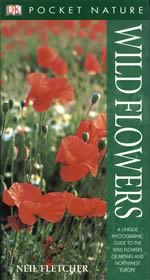
Wild Flowers by Neil Fletcher is very good for identifying plants, each plant has a photo of the plant, a photo of the plant in it’s habitat, a closeup of the leaves and a closeup of the flower plus text explaining identifying features.

Another quick tip to help with identification – if you go to www.images.google.com and enter the plant name you will get lots of photos (although this is not always accurate, always double check before eating anything!)

Why Walking Barefoot is Important

I just watched this fascinating video from David Wolfe about grounding and why it is important. He shows live blood analysis with people before and after grounding. This reminds me of the time when I walked barefoot loads and felt that while barefoot my eyesight was improving. Now I’m sure David Wolfe wants to sell you all sorts of gadgets to help ground yourself, but of course you can do it for free – walk barefoot whenever you can.

[Update: video no longer available.]

This video was part of the Longevity Now conference.

Photos from our travels: Part 3 – Mediterranean France

Getting into the swing of this now! Here are some photos from the first couple of weeks of August. As before click the map and photos to see large versions.

St-Quentin-de-la-Poterie was a fascinating little place. In the past it had been a commercial pottery town, making tiles and such like. Several years after the heavy industry closed down independent artisan pottery studies started opening up, now there is something like 23 studios. If you like ceramics, it’s worth checking out! Anyway, to the photos, this was a mosaic on the street. Cevennes National Pak. This is in Bédouès where our campsite was. We liked this area and the nearby town of Florac which had an interesting market.
We went for a walk from the campsite in Bédouès, Cevennes. We never like to take the same route back but we hadn’t got a map so we took a bit of a risk. Turned into the longest walk ever, didn’t get back to the van until sometime after 10pm! At the bottom of the campsite was this river and lots of wild greens for fresh juice.
Gorges du Tarn, on the edge of the Cevennes National Park. The gorge is over 30 miles long and very beautiful, went for a good walk, although the trees generally obscured the view of the gorge, we got the best views from walking along the road. Flamingos in the Carmargue area, not far from Montpelier.
The amphitheatre in Nímes, over 2000 years old and still standing In a little place called Ginac, campsite by the river.

Photos from our travels: Part 2 – Italy

Oops, I’m a bit slow with this, here are some photos from July. We were in Briançon, only 10km from the border with Italy so we decided to pop over for a quick visit. The first night we camped wild and saw the most amazing sight, lots of fireflys. First time I’ve seen them, they fly around flashing a little light on and off, the affect is best when there are a lot of them. I did take a photo, but it came out black! We covered a lot more ground in a short time in Italy, we whizzed down the motorways to get to a few interesting places, unlike France where we mostly stayed off the motorways on the smaller roads.

Click on the map and photos to see larger versions:

Santa Isola, Italy – This was quite a random stop (like many of the places we have seen), we were driving along and stopped for a little walk and found this beautiful lake and river. Wanted to go in the water but it was very cold (in the mountains), just got my feet in for a few minutes. Out of the mountainous area, we did find a beautiful river to swim in, really warm, but I can’t remember the place name or river name! The sea on the coast at Marina de Pisa was also lovely and warm for swimming.
In Tuscany we went to a few interesting towns and villages with old buildings, Volterra, San Gimignano and Siena. These three photos are from Siena. I’m not religious (far from it) but churches and cathedrals are often beautiful buildings and this one was one of the most ornate I have ever seen.
Back on the coast, this is Vernazza, one of the five villages known as the Cinque Terra. I thought we were in Russia for a moment, but it turns out we were in San Remo This is somewhere in the Alps on the border between Italy and France.
More in the alps. Back in France, Gorges de Daluis (Alps). This was a beautiful area, the photos don’t do it justice.
A place called Annot. Not the most amazing place, but the campsite was great.

Nettle Soup Recipe

We’re back in France! Yesterday, in the Loire Valley, we went to pick wild greens for dinner, but there wasn’t much selection, mostly just nettles. So Jolita suggested we have nettle soup. This is what I made, quantities are very approximate, I didn’t weigh anything, I just guessed at the end as it was so good.

  • Big bag of nettle tops – maybe about 100g
  • 1/2 orange pepper
  • 4 soaked sun dried tomatoes
  • 20g royal kombu seaweed (I’m sure other seaweed would work)
  • 1/4 tsp miso
  • olive oil
  • few squeezes lemon juice
  • 1/2 medium avocado
  • water

Put everything except the avocado into the blender. Add a little olive oil and maybe 1/2 a cup of water. Blend well, adding more olive oil or water if you need to make it blend better. Obviously you need to make sure that all the nettles are completely broken down, you don’t want to get stung in your mouth when you eat! Once it is smooth, add the avocado and give it a quick blend until smooth.

Enjoy! Let me know if you make it and how it goes, and if you have any variations.

The most important discovery in recorded history?

Tony Wright seminar London

The book Left in the Dark is one I recommend to everyone, so I also highly recommend this talk. Tony has a new theory about “The root cause of our obvious insanity and relentless capacity for self inflicted humanitarian and ecological catastrophe was staring us in the face, we were just too deluded to see it.” It’s a theory of why we are in the current world situation, and how we can get out of it.

Tickets £10. For more information and bookings email info@kaleidos.org.uk or tel 01736 811291 or 01726 71520. Venue: The Future Gallery, 5 Great Newport Street, London, WC2H 7HY.

For more on Tony’s theory and his book see www.leftinthedark.org.uk New website: www.childrenoftheforest.info (His book Left in the Dark is also on sale at the Funky Raw shop and there are also links to a radio interview with Tony on that page.) Update: Tony’s book has been republished under the new title Return to the Brain of Eden in 2014, see the linked website for details.

Raw Food and Traditional Chinese Medicine

An objection some people have to raw food is “According to Traditional Chinese Medicine (TCM), all raw food is cold and damp and will cause spleen chi deficiency”. Now there are various answers to that, but a friend of mine who is studying TCM has decided to do a study to find out if that is true or not. The study involves having a Chinese Doctor examine the tongue and pulse, two techniques used in TCM of a sample of raw food eaters compared to a sample of non-raw eaters

So yesterday, a Chinese Doctor looked at my tongue and checked my pulse. The way they check the pulse is not like a Western doctor would, they are not counting the beats per minute, they are looking at 30 (I think) different aspects. So the result was, tongue normal, pulse very slightly “slippery”. According to my friend doing the study, a “slippery pulse” could be an indicator of spleen chi deficiency, but with me it was minor and my tongue was normal, so  it seems I am ok. There is still another part of the study which is a questionnaire which will check if I have any other symptoms, I’ll let you know when I have the results of that.

When the study is complete this will hopefully give a better answer to the objection. (Apart from all the healthy people who have been following a raw food diet for many years!)

France Photos part 1

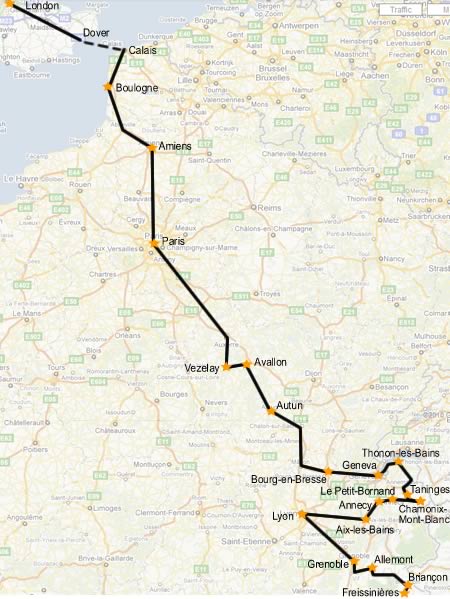
If you’ve been following this blog, you will know that we set off on June 1st in a camper van. Below is an approximate map of wheer we went for the first five weeks of our trip, and below that some photos. From Briançon we went through the mountains over into Italy for a couple of weeks, I’ll put photos and a map of the next sections of the trip up soon.

Travels in France Part 1 map

Click on any photo to enlarge it.

Wimereux, between Calais and Bologne has some interesting buildings. Wild rocket near Paris! Gecko in Bourg-en-Bress
We stayed at Chavannes, near Bourg-en-Bress. beautiful campsite by a river and lots of walks in the area. Driving through the mountains towards Geneva we saw this beautiful lake. Bright and colourful architecture in Geneva (yes, we popped over the border into Switzerland for a couple of days)
St. Johns Wort flower at a herb garden in Geneva Stayed in Taninges in the Alps for a few days, it rained a lot but on the nice days we had some beautiful walks
Sculpture in forest at Taninges
A beautiful lake not far from the campsite. No rain on our last day in Taninges so we went for a long walk into the forest. Saw all kinds of wildlife and mushrooms (not sure what they were though) plus some fun sculptures.
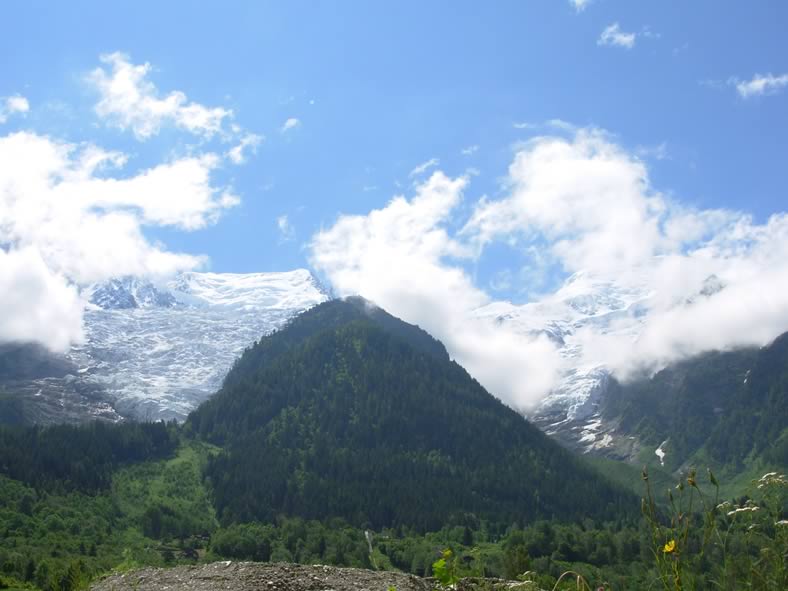
Interesting mushroom at Taninges Another mushroom at Taninges Chamonix-Mont-Blanc in the Alps
Wild mushrooms, Taninges. Chamonix-Mont-Blanc is in the Alps, about 15km from the border with Italy. It was amazingly beautiful…
More photos of Chamonix. We also found the best wild strawberries here.
Interesting flowers near Briançon
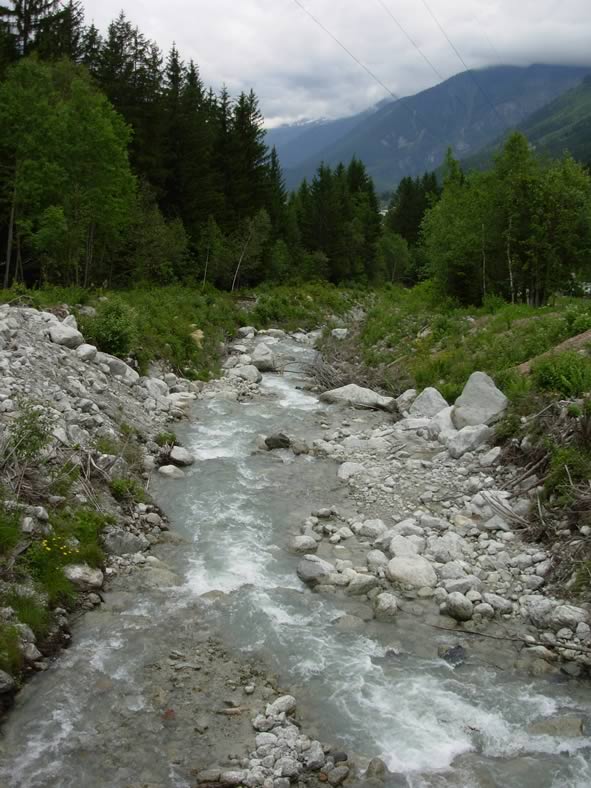
A final waterfall photo at Chamonix. Le Petit-Bornand-les-Glières was a random stop on the way to Annecy. Tiny campsite in a sleepy village, very pretty. In the mountains near Briançon, beautiful area and interesting town with great market and several good organic fruit and veg shops.