Juice in a Bar review

I was sent samples of Jason Vale’s new raw Juice Bars: Veggie Juice in a Bar and Super Fruit Juice in a Bar. I was intrigued at the idea of how they could make juice into a bar, the answer was obvious once I looked at the ingredients – the first two ingredients for both bars are dates and almond butter, so these are standard energy bars with the addition of juice. I can’t see anywhere where it says the percentage of juice compared to the base ingredients.

First I tried the Super Fruit bar – first reaction is that it is very sweet, with the dates overpowering the flavour of the juices. Overall a nice bar, although I wouldn’t buy it as it is so sweet.

Much better, the greens tempering the sweetness a little, so while still sweet, a much more balanced bar. There is a “green” flavour to this bar which some people might not like (my Dad liked it and my Mum didn’t), but it’s worth it to get the mineral rich greens. If you generally eat this kind of energy bar, then maybe switching to this one would be a good move so you get a load of nutrition from the greens and algaes into your diet. It contains a lot of good ingredients including wheatgrass, dandelion juice, kale juice, spirulina, chlorella, kelp and dulse, plus also digestive enzymes. I would be interested in what percentage of the bar the dates and almonds make up. Of course if you have the option, I would recommend a fresh green juice, preferably made with lots of wild greens, but if you don’t have that option then this is an ok substitute. But don’t go overboard, there are still a lot of dates in this bar.

Find out more and order at www.juicemaster.com

The Funky Raw Magazine

If you don’t already know, I publish a quarterly magazine, the main topic of which is raw food and healthy eating, but it also covers many other topics including environmentally friendly living, permaculture and growing food, spirituality, living consciously and more. It is a grassroots magazine, mostly written not by journalists but by people writing from their own experiences.

If you want to see for yourself what it is like we now have two back issues available as free ebooks (PDF files), follow the links to download your copy: Issue 10 (Spring 2007) and Issue 18 (Winter 2010/11). If you prefer printed copies, we have two selections of back issues available at a discount: Issues 14 to 18 and Issues 4,5,6,11 & 13. The current magazine is Issue 19 Spring 2011 which can be purchased as a printed magazine or an ebook. Why not subscribe and get each issue delivered direct to your door.

There are several ways I want to take the magazine forwards which I want to talk about more below.

Writing for the magazine

I’m always open for new writers, whether for a single article or to be a regular writer. You can write on raw food or any related conscious living subject, the main rule is to keep it positive – the news media is full of negativity so at Funky Raw we try and look to how to move forward positively. There is a list of article ideas on this page, but if you have your own ideas please also get in touch.

As well as feature articles, there is also space for news, raw recipes, reviews (books, films, restaurants, etc), cartoons, poetry, etc. There is no set length for articles, short articles can work just as well as long articles.

Every cover features artwork, while I have artists lined up for the next couple of issues, please feel free to contact me if you would like to offer your artwork.

Distribution

In the UK and Ireland we are distributed by Ink Distribution. If you want to get your local health food shop to stock the Funky Raw magazine, tell them to order it through Ink Distribution. Otherwise, wholesale copies of the magazine can be ordered direct through our online shop or by contacting me directly on magazine@funkyraw.com

It would be great to get the magazine distributed in the USA and Canada, if you have any ideas on this please get in touch.

Spreading the word

If you have a blog or website and would like to write a review of the magazine, email me at magazine@funkyraw.com and I will send you a free copy. If you have any other ideas on how to promote the magazine, please leave a comment or email me.

Testamonials

Here’s what some people have said about the magazine:

I have so many books on nutrition at all levels, watch YouTube discussions on raw eating, David Wolfe, etc, but none of them compare to your magazine!! I have ordered some back issues and re-read them over and over, even going to take them on holiday with me next month. Why? because I find that the articles you print are varied, motivating and informative and better than any book because there is always another to look forward to. Please don’t ever change how you present this magazine, it out rivals its high gloss contenders in its simplicity (in the best kind of way) it is perfect. I see your magazine as the bridge for me to reach my goal of becoming a Raw Food Eater!!!! It is the inspiration I need. – Deana, Essex

Just to say I loved your magazine. I ready it cover to cover. It was refreshing to read media that is ‘real’ like from person to person sharing stories and wisdom rather than the usual. I really liked the cover artwork too. – Fiona

Remember, you can download a free PDF version of these two issues, just click the cover images below:

Crucina – New raw food restaurant in Madrid

We’re on our way north again, heading back to the UK for a little while. As we were passing near to Madrid we decided to take the opportunity to visit Crucina, probably Spain’s only 100% raw restaurant. Crucina is a combination of two Spanish words – the start of crude meaning raw and cocina meaning kitchen.

Crucina is centrally located in the Malasaña district of Madrid, less than 5 minutes walk from San Bernardo metro startion.

We arrived to a very warm and friendly welcome from Yorgo, one of the co-owners. The ambiance is great, smart and modern, although they do have plans to make the décor more unique and creative. The menu was of course in Spanish, they are planning to have English menus, but for now both owners speak English so they can translate anything you don’t understand. The menu is comprehensive: juices, soups, salads, starters, mains, deserts and drinks.

We started with juices – I had “Purificaverde” – Green Purification with spinach, cucumber, celery and lemon, very refreshing although a little bland (I’m used to much stronger wild green juices!). Jolita had “Anticolesterol” with carrot, ginger, apple and parsley, which was delicious. (We shared all our food, so got to taste twice as much!)

For starters, I had the “Trio de Tartletas”, three little savory tarts, each with a different filling. The ‘pastry’ casing was unfortunately a bit too hard, almost rock solid and I couldn’t eat it, although the fillings were really delicious. Jolita had the “Tabla de Kesos”, the cheese plate. In Spanish, cheese is spelled Queso, so the alternative spelling Keso is to denote vegan cheese! Two different nut based cheeses, some raw jam, and at least 4 types of raw crackers, it was all delicious.

Trio de Tarteletas Cheese Plate

MoussakaI always used to love Moussaka when I ate cooked food, so when I saw it first on the menu, I just had to have it. After reading further it was a toss up between that and the Saag Hindu, but Jolita chose that so all was well. It turns out that Yorgo is originally from Greece, and he wants to include more Greek dishes in the future.

The moussaka was great – aubergine is not always the best thing raw, but they suceeded by cutting it very thinly and dehydrating – it was a bit chewy but good. The ‘meat’ was tasty and the ‘cheese’ and tomato sauces were delicious, overall a great dish, just slightly too salty for me (I don’t usually add salt to my food, so I’m quite sensitive  to too much salt).
Saag HinduSaag Hindu was a spicy Indian dish made with spinach and ‘mango chutney’ (more a mango sauce than chutney) which was served with some spicy coconut based breads. This again was delicious, the spicyness was just right, tasted like food from an Indian restaurant!

I was getting a bit full by now, but the deserts sounded too tempting to pass over. We ordered the tiramisu and the “Pudin de Chia”. The chia pudding was good, but a little bland, although the strawberries and banana it was served with did go well with it.

The tiramisu was amazing! Excellent textures and flavours, definitely among the best raw deserts I have ever eaten.
Chia Pudding Tiramisu

In conclusion, if you are anywhere near Madrid this is well worth a visit. And their plan is to open another restaurant in Barcelona later in the year, so keep listening out for news of that.

Crucina, Divino Pastor, 30, Madrid. Tel: 914453364. Opening hours: Tues – Wed: 13:30 – 16:00, Thurs – Sat: 13:30 – 16:00 and 21:00-24:00, Sun: 13:30 – 16:00

Pumpkin Pate with Kelp and Chlorella

I wanted to make something with both kelp and chlorella, it was a bit of a random experiment but it turned out really nice.

Grate the ginger and stir in the oil. Add the powders and stir in. Grate the pumpkin on the finest grater you have, I think what I used is called a microplane, a really fine grater. I guess you could blend or food process the pumpkin instead if you prefer. Mix the grated pumpkin in with everything else. Hope you like it!

How to Protect Yourself from Radiation

David Wolfe has done an excellent podcast on how to protect yourself from radioactive fallout – I recommend you listen to it now: David Wolfe on Radiation. Here’s a quick summary of what he recommend to take, many of which we sell on the Funky Raw website, so I’ve linked these items:

  • Kelp – for iodine (all seaweeds are good, but kelp has the most bio-available iodine).
  • Ginseng
  • Ashwaganda
  • Chlorella (for the chlorophyll, chlorella is the food highest in chlorophyll, 40 times higher than wheatgrass)
  • Zeolite (for detoxing)
  • Fulvic acid
  • Sea salt and salty miso
He also says that the following are useful:

Fermented Broccoli and Carrot with Leek

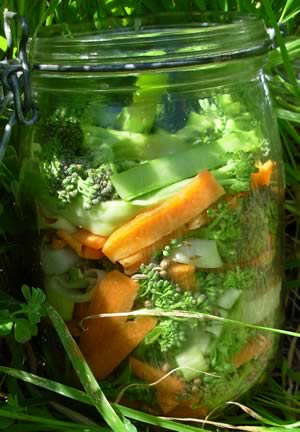
Fermented broccoli and carrotThis was my first attempted at fermenting vegetables and it worked really well, although I think I put too much salt in. I followed the technique on pages 50-52 in the book Wild Fermentation “Sour Pickles”.

I sliced the carrots and cut the broccoli up, you can see the approximate sizes in the photo. I then sliced some leek,  I think I used about 1/4 of a leek. I used a couple of handfuls of coriander seeds and cumin seeds to flavour it, some whole and some crushed.

I put everything in a kilner jar and added water with salt dissolved in it, I think for this 1 litre jar I used 500 ml water with 1 and a half tablespoons of salt, but if I did it again I would use less. I then put a clean (well scrubbed) stone on top of the veg to hold it under the saltwater solution. After about 2 weeks fermenting they had an amazing flavour, but you can try them during the whole process to see how they develop.

You need to check them daily and if any mould forms on the surface it needs to be removed.

My daily diet – what a raw fooder eats

My diet has changed a lot in the last year particularly with the addition of lots of fermented foods and more animal based foods. This is a typical day, obviously I don’t eat the same thing every day. And it’s an experimental diet, I could change it again at any point!

For breakfast, I eat a hemp milk pudding. In the past I’ve talked about this a lot (as chocolate pudding), although at the moment it usually doesn’t contain chocolate.

The ingredients are as follows (for 2 people):

  • 150g hemp seeds, soaked overnight
  • handful of seeds soaked overnight, drained and rinsed – different seed each day, rotated through sesame seeds, sunflower seeds and pumpkin seeds
  • 2 figs, 2 apricots and a handful of goji berries soaked overnight
  • 2 bananas
  • 2 teaspoons pollen
  • 2 teaspoons mesquite meal
  • 2 teaspoons carob powder
  • either 1 teaspoon maca or 1 teaspoon suma powder
  • 1/2 teaspoon camu camu powder
  • 1/2 teaspoon vanilla powder
  • 1 tablespoon butter (grass fed dairy butter)
  • 2 teaspoons coconut oil
  • piece of aloe vera about 5cm long (with skin removed) if available

Occasionally I’ll add some raw cacao beans, around 10 beans for 2 people. It’s not the same every day, ingredients vary depending on what is available. Pears work well when they are in season, sometimes to replace a banana. I won’t type the full method, you can see it in the previous choc pudding post, but basically make hemp milk and then blend it with all the other ingredients.

I eat the pudding with some kefir made with raw milk, usually goats milk while we are travelling in Spain. Kefir is a wonderful fermented foods full of probiotic bacteria. If available I will also have  a little raw cream or creme fraiche.

Update: I’ve started taking 5ml fermented cod liver oil and 2.5ml high vitamin butter oil along with my breakfast, to cover the important vitamins A, D3 and K2.

Lunch is usually composed of two separate smaller meals, one maybe around 12-1pm and the other around 3-4pm

Usually the first one will be some fruit, whatever is in season, at the moment maybe oranges, custard apples (cherimoya) or apples. At other times of the year figs, kakis, pears, plums, etc. Usually I will only eat one type of fruit in a meal.

Later I’ll have two or three raw egg yolks, beaten up with some kefir, and something to flavour it, mesquite, lucuma and raw honey works well. This is a new and experimental part of my diet, it seems to be working for me at the moment but I’ll see how it makes me feel over the long term.

Just before dinner I will have a glass of kombucha, before a meal it can help with digestion and detoxification.

Dinner is a large salad – lots of wild greens, half an avocado, seasonal vegetables, fermented foods like sauerkraut and home made pickled veg (see my review of Wild fermentation for more on fermented foods), seaweed and raw cheese. Once or twice a week I’m experimenting with more animal food, raw fish (marinated in lemon juice), raw cured meat or liver pate (some of the only cooked food I’m currently including.) This is based on information from Weston Price.

After dinner I’ll sometimes have a snack of dried figs with grass fed butter. Butter must be from grass fed animals for it to include the important vitamins A, D and K, plus activator X. With cows butter, the colour should be yellow, if it is white it doesn’t have the required nutrition. Try getting butter from your local farmers market, but if you have no success with getting quality butter, Kerrygold butter from Ireland is grass fed and high quality. (And Anchor butter from New Zealand if you are in that part of the world.)

Water: throughout the day I drink water with a squeeze of fresh lemon juice. I try to drink freshly collected spring water wherever possible. If not available, I will always filter tap water before drinking.

Some of you will be asking why? I think my previous diet contained too much fruit and this has caused problems with my teeth. I’ve been reading two books Diet and Nutritional Degeneration by Weston A. Price and Cure Tooth Decay by Ramiel Nagel which have helped me to change my diet. I’ve written more about Weston Price here: The key ingredients of healthy diets and I will write more about the Cure Tooth Decay book once I have finished reading it.

Wild Fermentation by Sandor Elix Katz – Book Review

This review was first published in Funky Raw issue 17, but I have been making more recipes from it since then so have added a bit of an update at the end.

The article on Wild Fermentation in the last issue of the Funky Raw magazine intrigued me so I went out and bought myself a copy of this book as recommended. I’ve recently been increasing the amount of fermented foods in my diet, both home made and store bought, so I thought it would be good to learn how to make more fermented foods for myself.

This book is very easy to read and much of what Sandor says resonates with me. The first few chapters set the scene, showing how past cultures used fermented foods and how things have changed with commercialisation and mass production of food in recent years.

I really like the fact that Sandor has written this book in a conversational style, and isn’t afraid to occasionally go off at a tangent, such as the time he went to harvest seaweed at 4am(!), plus interesting asides about life in the community where he lives.

Sandor has been learning about fermented foods for the last 10 years and the level of research which has gone into this book is astounding, it is well referenced and has a large bibliography so you can keep learning.

The book covers a wide range of fermented foods, some of which won’t be of interest if you are a strict raw fooder, but there are enough raw (or live) recipes to make this book worth while. Recipe chapters include vegetable ferments (sauerkraut, kimchi, pickles), bean ferments (miso, tamari, tempeh), dairy ferments (yogurt, kefir, cheese, vegan alternatives), bread, porridge, wines, beers and vinegars.

Each recipe is clearly laid out with detailed instructions, plus also ideas for making your own variations. Sandor keeps telling us how easy it is to make fermented foods – explaining how humans have been fermenting for thousands of years without any modern technology or shops to buy yeasts from, fermenting using wild yeasts and bacteria which is in the air all around us.

I thoroughly recommend this book, but if this review hasn’t convinced you, read the extract (printed in the Funky Raw magazine).

188 pages. Published by Chelsea Green. ISBN 978-1931498234. www.wildfermentation.com

Updated comments, Feb 16th

The first recipe I tried from this book was mead, a very simple ferment using just honey and water. It can be quite strongly alcoholic, but I only fermented it for two weeks to make a milder drink. It worked really well and was delicious.

As you saw in my last post Making Cheese, I also made one of the cheese recipes, which worked really well and I’ve been making it regularly for several weeks, now I’m looking forward to experimenting more with cheese.

One point I forgot to mention in the original review is the word “wild” in the title – this is in reference to wild yeasts and bacteria – many fermentation recipes call for adding shop bought yeasts or bacteria, whereas Sandor likes to rely on the wild versions in the air all round us, which makes for more authentic ferments.

The more I read, the more I love this book. It’s inspirational and the more I make and eat fermented foods, the more I want to learn and experiment. My next project from this book will be Kimchi… I recommend you go out and buy this book right now!

Why Walking Barefoot is Important

I just watched this fascinating video from David Wolfe about grounding and why it is important. He shows live blood analysis with people before and after grounding. This reminds me of the time when I walked barefoot loads and felt that while barefoot my eyesight was improving. Now I’m sure David Wolfe wants to sell you all sorts of gadgets to help ground yourself, but of course you can do it for free – walk barefoot whenever you can.

[Update: video no longer available.]

This video was part of the Longevity Now conference.

Nettle Soup Recipe

We’re back in France! Yesterday, in the Loire Valley, we went to pick wild greens for dinner, but there wasn’t much selection, mostly just nettles. So Jolita suggested we have nettle soup. This is what I made, quantities are very approximate, I didn’t weigh anything, I just guessed at the end as it was so good.

  • Big bag of nettle tops – maybe about 100g
  • 1/2 orange pepper
  • 4 soaked sun dried tomatoes
  • 20g royal kombu seaweed (I’m sure other seaweed would work)
  • 1/4 tsp miso
  • olive oil
  • few squeezes lemon juice
  • 1/2 medium avocado
  • water

Put everything except the avocado into the blender. Add a little olive oil and maybe 1/2 a cup of water. Blend well, adding more olive oil or water if you need to make it blend better. Obviously you need to make sure that all the nettles are completely broken down, you don’t want to get stung in your mouth when you eat! Once it is smooth, add the avocado and give it a quick blend until smooth.

Enjoy! Let me know if you make it and how it goes, and if you have any variations.